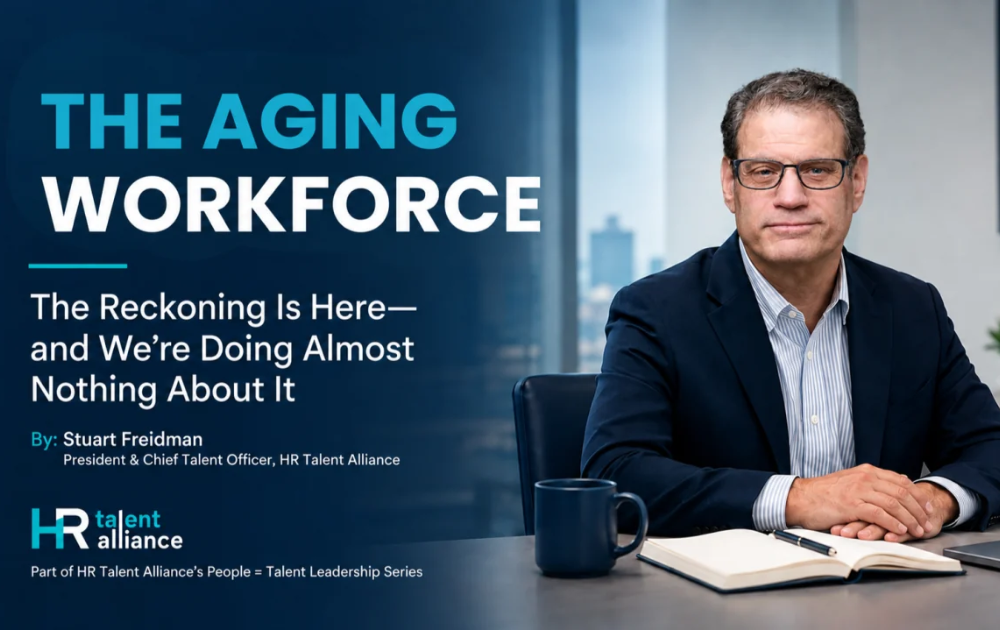
The Reckoning Is Here—and We’re Doing Almost Nothing About It
Part of HR Talent Alliance’s People = Talent Leadership Series, By Stuart Friedman
We have been talking about the aging workforce for years. Now the reckoning is here, and most organizations are still behaving as though it is someone else’s problem.
I increasingly work with talented, accomplished professionals who are being aged out of the workforce earlier and earlier. These are not people who have stopped learning or lost their drive. They are experienced senior managers, executives, subject-matter experts, and trusted leaders who have spent decades building teams, solving problems, navigating change, and delivering results.
Then comes the "reorganization." The position is eliminated. The department is restructured. The organization decides it can hire someone younger, less expensive, and—yes—perfectly competent. The calculation seems simple: Why retain the experienced executive when we can hire someone at 70% of the compensation and get approximately the same work?
Except we are not getting approximately the same thing. We are losing:
Judgment and institutional knowledge
Leadership maturity
The ability to recognize a problem before it becomes a crisis
The confidence that comes from having lived through recessions, restructurings, acquisitions, leadership changes, difficult clients, failed strategies, and successful turnarounds
Experience is not simply the number of years someone has worked. It is the accumulated knowledge of what works, what does not, and what happens next. But beyond the individual organizations making these decisions, we need to confront a much bigger question: What the hell are we going to do with millions of experienced professionals who still need—and want—to work?
We tell people that the old career model is gone. People no longer stay with the same company for 20 or 30 years, and careers are no longer linear. We encourage professionals to reinvent themselves, change industries, develop new skills, pursue a second or third career, and remain active longer. Then, when they try to do exactly that, we do not hire them. Instead, we say:
• They are "overqualified."
• Their experience is "too senior."
• They will become bored.
• They will expect too much money.
• They will leave as soon as something better appears.
Let’s at least be honest with ourselves. The "overqualified" label is usually BS—a simple, polite answer that avoids the real conversation. In my career advisory work, I sometimes recommend that clients remove graduation dates from their résumés. But even that can trigger assumptions from recruiters, including me, if we are not careful. The year someone graduated should not matter. What should matter is whether the candidate has the experience, genuinely wants the job, and still wants to learn, grow, and contribute.
Instead, candidates are told to reposition their experience, minimize their accomplishments, shorten their résumés, remove graduation dates, and somehow appear younger without appearing dishonest. Basically, dumb down their résumé.
Years ago, one of my proudest placements was an experienced warehouse manager who had been displaced after a merger. My client was a growing small business preparing to move into a warehouse three times its current size. They needed someone who had done this before, and this candidate had more than 20 years of experience.
The owner thought he was the most qualified candidate he had met but initially did not want to hire him. Why? He was uncomfortable managing someone older than himself. That became part of my job as the recruiter: advising the client, addressing the concern directly, and putting enough structure around the relationship so both people were comfortable. The warehouse manager became one of the company’s best hires and stayed until he retired several years later. By then, the company had grown enough to hire a VP of Operations.
We have created an absurd contradiction. We tell people to keep working, learning, and reinventing themselves, and then penalize them for having worked, learned, and accumulated experience.
Look around your own professional network:
• How many exceptional professionals do you know who are currently "in transition"?
• How many have been searching for a year or longer?
• How many people who once held senior leadership positions are struggling to get interviews for roles they could perform exceptionally well?
• How many of your strongest employees disappeared during the latest reorganization because their compensation made them an attractive line item to eliminate?
These are not isolated stories. Millions of people are in this position, and it is happening earlier and earlier—not only to people in their 50s or 60s. Ask yourself when you plan to stop working. I did not say retire. I asked when you will want to stop working.
Meanwhile, employers continue to complain about talent shortages, leadership gaps, a lack of qualified candidates, declining employee engagement, and managers who are unprepared to lead. Perhaps the talent is not missing. Perhaps we have simply decided not to see it.
This does not mean every experienced professional is automatically the right hire, and it does not mean younger professionals should be denied opportunities. They absolutely should be given them. This is not a competition between generations; it is an argument for building stronger, multigenerational organizations. Younger professionals bring new perspectives, current technical knowledge, energy, and different ways of approaching work. Experienced professionals bring context, judgment, mentoring capability, and the ability to see around corners. Organizations need both.
The solution is not to preserve every senior position forever. Businesses change, roles evolve, and restructuring is sometimes necessary. But leaders need to stop treating experience as an expensive liability and begin thinking more creatively about how to use it. That may mean:
• Hiring experienced professionals into roles different from the ones they previously held
• Using fractional leadership, project-based work, advisory roles, interim assignments, mentoring, consulting, or flexible schedules
• Looking beyond titles and compensation history to understand what problems someone can solve now
Overqualified???
Most importantly, it means challenging the lazy assumptions behind the word "overqualified." Overqualified for what—solving the problem, leading the team, supporting the organization, or delivering results? Or simply for fitting neatly into a salary range and an outdated idea of what the ideal candidate should look like?
The aging workforce is not a future workforce issue. It is already here. Experienced professionals are being pushed out, employers are failing to use an enormous pool of talent, and people who expected to remain productive for another 10, 15, or 20 years are discovering that the workforce may have other plans for them.
We cannot continue telling people to reinvent themselves while refusing to give them the opportunity to do so. The world of work has changed, and nontraditional arrangements are now a meaningful part of it. Those of us who are slightly more mature and still want—or need—to work must also be open to different options, whether that means fractional work, an advisory role, a new direction, or something else entirely. In my career advisory practice, I am seeing more professionals explore what their next act might be.
One recent client held a senior position and believed his company might reorganize within the next year or two. He still wanted to work, but he no longer wanted all the responsibility he had carried before. He did not want to manage a division. He wanted to work for another ten years or so in a less stressful role, and he was comfortable earning less in exchange for greater work-life balance.
We cannot claim there is a talent shortage while ignoring millions of talented people. We also cannot call ourselves people-centered organizations if people become disposable the moment their experience costs more. People = Talent. That should not come with an expiration date.
The Leadership Challenge
Take an honest look at your organization:
How many experienced professionals have you hired in the past two years?
How many have you rejected because they appeared overqualified?
How many of your best employees were eliminated in the latest reorganization?
How much knowledge, judgment, and leadership walked out the door with them?
The aging workforce is not someone else’s problem. It is a leadership reckoning, and it is already here.